



Mamun Matubber is fully aware of his role as an expert beekeeper—a passion that has become his profession. It represents the present and future of a young man—now an adult—who arrived in Calabria from Bangladesh in 2018.
A year in Settingiano, in the heart of the Catanzaro isthmus, followed by a period in Lamezia Terme, where beekeeping training began at the Luna Rossa Community—initially through the national BeeMyJob project and subsequently with Aprocal.
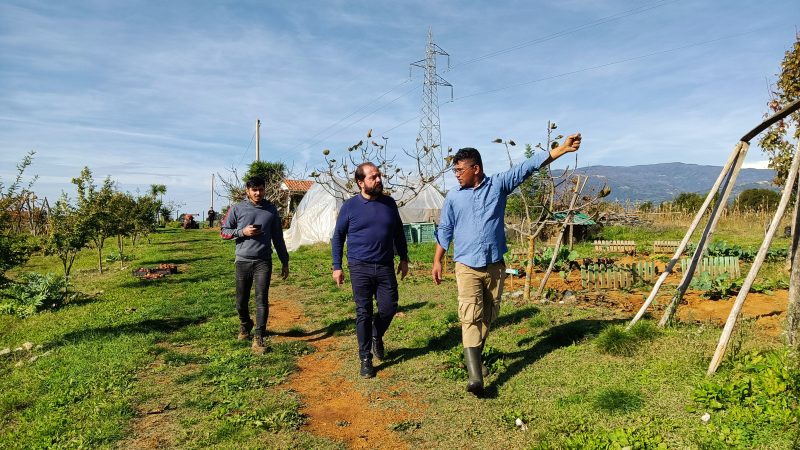
At the *Erbaio* (herb garden) of the Comunità Progetto Sud—a plot cultivated through the efforts of the “Le Agricole” cooperative and frequented by individuals undergoing social rehabilitation as part of the Community’s social programs—Mamun tends to his beehives alongside Foysal, who has become his trusted collaborator.
“I’ve learned to understand what they do and what they want to do,” says Mamun. “It took some time, but experiencing nature and observing the life of the bees brings me peace.”
As he speaks, Mamun seems to embody Confucius’s famous quote: “Choose a job you love, and you will never have to work a day in your life.”
“It is part of the educational and ecological mission of Comunità Progetto Sud and Le Agricole,” says Nicola Emanuele, head of Luna Rossa and this beekeeping project, “to establish a close relationship with the land and nature—embodying the role of farmers grounded in values and social initiatives—as well as to create employment opportunities within social agriculture.”

This is how pathways were created to introduce people to agriculture in general, eventually leading to an engagement with beekeeping. The training and subsequent work opportunities were aimed at individuals facing social disadvantages—whether due to migration backgrounds or other experiences of marginalization.
The industriousness and fascinating social structure of hive life teach us that bees are not only the first link in the natural chain—with the health of all living beings depending on theirs—but also that, like everything in nature, they live by precise rules aimed at achieving social and productive balance.
“I like the queen bee—how she establishes order and acts as a leader who knows the worker bees,” says Foysal Matubber shyly.
Today, we can report a dual success: while the *Comunità Progetto Sud* continues its cultural and ecological work—using its ten-hive apiary for training, education, and awareness-raising—the social cooperative “Le Agricole” is ramping up production of organic honey and other bee-derived products (such as propolis and pollen), all while facilitating the employment of individuals facing social disadvantages. Mamun—who has since become a member of the “Le Agricole” cooperative—now manages an apiary comprising 77 hives at the *erbaio* (forage field) site and another 70 hives at the S. Pietro Lametino location.